


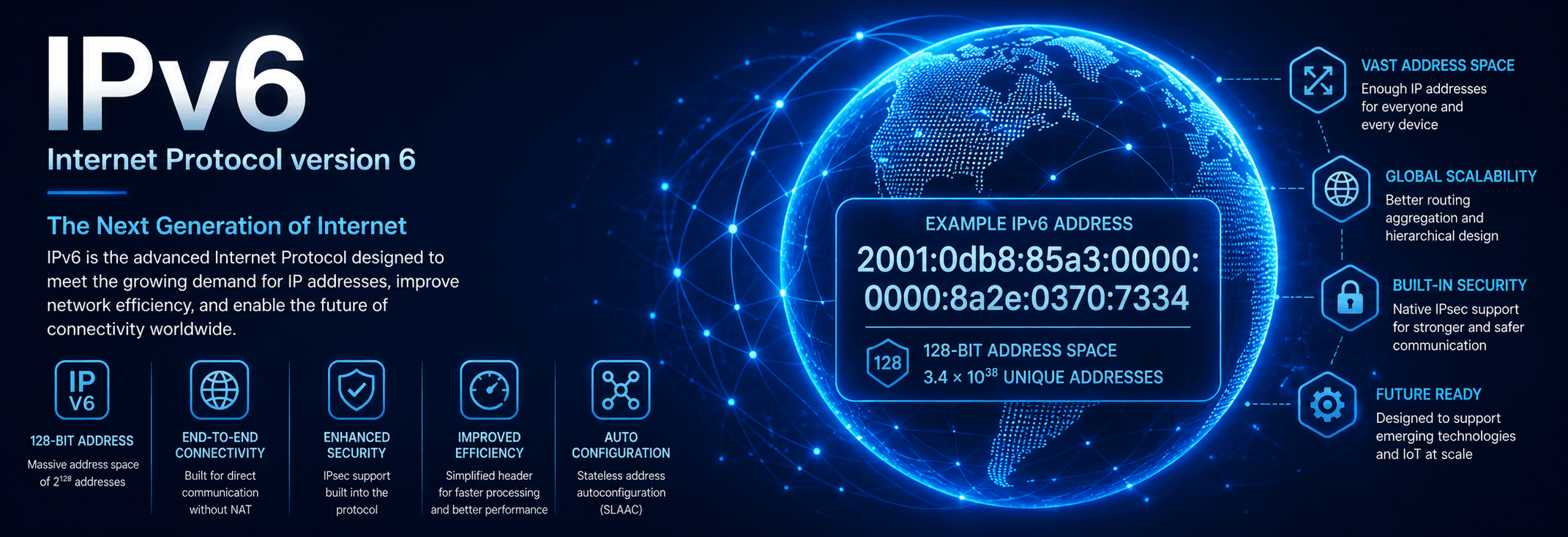
IPv6 (Internet Protocol Version 6)
IPv6 (Internet Protocol Version 6)
1. Why IPv6 Exists (Fundamental Problem)
IPv6 was designed primarily to solve one unavoidable limitation of IPv4:
Address exhaustion
IPv4 provides:
- (2^{32} approx 4.3 ) billion addresses
That sounded huge in 1980. It’s trivial today.
Key milestone
- Exhaustion officially recognized around 2011 (RIR depletion, e.g. RIPE NCC)
2. Core Design Philosophy
IPv6 is not just “more IPs.” It’s a redesign based on:
- End-to-end connectivity (no NAT dependence)
- Hierarchical routing (aggregation-friendly)
- Simplicity in packet processing
- Built-in extensibility
3. Address Space — The Real Scale
IPv6 uses 128-bit addresses:
[2^{128} approx 3.4 times 10^{38}
]
That’s enough to assign:
- trillions of addresses per human
- or practically eliminate scarcity
4. IPv6 Address Representation
Hexadecimal format
2001:0db8:85a3:0000:0000:8a2e:0370:7334
Compression rules
- Remove leading zeros:
2001:db8:85a3:0:0:8a2e:370:7334
- Replace longest zero sequence with
:::
2001:db8:85a3::8a2e:370:7334
Important:
::can be used only once
5. Address Structure
IPv6 addresses are divided into:
- Global Routing Prefix
- Subnet ID
- Interface ID
Typical format:
2001:db8:abcd:0012::/64
- First 64 bits → network
- Last 64 bits → interface (host)
6. Address Types (Critical Concept)
IPv6 eliminates broadcast and replaces it with more efficient mechanisms.
1. Unicast
One-to-one communication
2. Multicast
One-to-many (efficient replacement for broadcast)
3. Anycast
One-to-nearest (used in CDNs, DNS)
7. Special IPv6 Address Ranges
Global Unicast
- Public internet addresses
- Prefix:
2000::/3
Link-Local
fe80::/10
- Automatically assigned
- Used for local communication (no router)
Loopback
::1
Unique Local (Private equivalent)
fc00::/7
8. Stateless Address Autoconfiguration (SLAAC)
One of IPv6’s biggest upgrades.
Devices can configure themselves without DHCP.
How it works:
- Device generates interface ID
- Router sends prefix (Router Advertisement)
- Address formed automatically
9. Neighbor Discovery Protocol (NDP)
IPv6 replaces ARP with NDP.
Instead of broadcast:
- Uses ICMPv6 multicast
Functions:
- Address resolution
- Router discovery
- Duplicate address detection
10. IPv6 Packet Structure (Simplified)
IPv6 header is fixed (unlike IPv4).
Key Fields:
| Field | Purpose |
|---|---|
| Version | 6 |
| Traffic Class | QoS |
| Flow Label | Packet flow handling |
| Payload Length | Data size |
| Next Header | Next protocol |
| Hop Limit | Like TTL |
| Source Address | Sender |
| Destination Address | Receiver |
Key Improvement:
No header checksum → faster processing
11. Extension Headers
IPv6 uses modular headers:
- Routing header
- Fragment header
- Authentication header
- ESP (encryption)
This makes IPv6:
- More flexible
- Easier to extend
12. Fragmentation Model Change
In IPv4:
- Routers can fragment packets
In IPv6:
Only the sender fragments
This improves:
- Router performance
- Network efficiency
13. NAT — Removed by Design
IPv6 is built to eliminate NAT.
Why?
NAT breaks:
- End-to-end communication
- Peer-to-peer systems
- Security models
Reality check:
Some networks still use:
- NAT66 (rare, not recommended)
14. Routing in IPv6
Routing is more scalable due to:
- Hierarchical addressing
- Aggregation-friendly prefixes
Protocols:
- OSPFv3
- MP-BGP (Multiprotocol BGP)
15. Security in IPv6
IPv6 was designed with:
- IPSec support (mandatory in spec)
However:
- Not always enforced in practice
16. Transition Mechanisms (Real World)
IPv6 didn’t replace IPv4 overnight.
Common methods:
- Dual Stack
- Run IPv4 + IPv6 simultaneously
- Tunneling
- IPv6 over IPv4
- Translation
- NAT64 / DNS64
17. IPv4 vs IPv6 — Engineering Comparison
| Feature | IPv4 | IPv6 |
|---|---|---|
| Address size | 32-bit | 128-bit |
| NAT | Required | Not required |
| Header | Complex | Simplified |
| Broadcast | Yes | No |
| Auto config | Limited | SLAAC |
| Security | Optional | Built-in support |
18. Real-World Deployment Reality
Here’s the truth most courses don’t tell you:
- IPv6 is widely deployed (Google, ISPs, mobile networks)
- BUT:
- IPv4 is still everywhere
- NAT is still dominant
- Many enterprise systems lag behind
Modern architecture:
Dual-stack is the real standard today
19. Key Engineering Insights
If you want to think like a network engineer:
- IPv6 is not just bigger — it’s cleaner design
- Removing NAT simplifies architecture massively
- Routing scalability is the real long-term win
- The hardest problem is not technical — it’s migration
20. Final Summary
IPv6 is:
- A 128-bit, scalable addressing system
- Designed for end-to-end connectivity
- Built with modern networking principles
- Structured for future internet growth
Yet:
It coexists with IPv4 — it hasn’t replaced it (yet).

